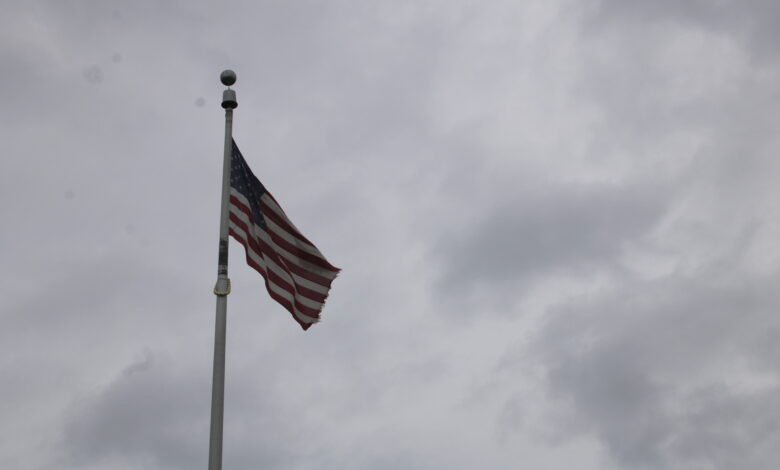
Every year, on September 11th, the morning announcements hold a much more solemn tone and message than the usual peppy morning welcome. Buffalo High School students, staff, and faculty begin their day at 8:50 am, just four minutes after the first plane hit the North Tower on September 11th, 2001. Together, the school holds a moment of silence in remembrance and honor of all those lost. This year, that moment of silence seems to hold a heavier weight, as it is the 25th anniversary of the nation being forever changed. So as everyone at BHS begins their first moments of the school day, we remember that 25 years ago, thousands were living through the final moment of theirs.
“I was completely unsure what was going on in the world. I was in 7th grade History Class with Barry Johnson,” Gym Teacher Josh Ortmann said. “I remember rumors initially going around that it was happening in Minneapolis, and the aftermath left such an unsettling feeling that it was hard to explain”.
As time progressed after the tragedy of 9/11, year after year, fewer and fewer students could remember the events of that day, until eventually no students had recollection of the day at all, solely because they would have been too young to remember, – or simply not even born yet. Over the years, this notion has brought an important discussion to the table for administrators and staff about whether recounting the events of the attacks was still the appropriate course of action.
“I remember the first time I made that announcement, and we [admin] realized that none of the students would have been alive yet; so we kind of had to sit down and reflect: is this still important?” Principal Mark Mischke said. “The course of history changed significantly that day. It changed how we approach our day, what we assume to be true, what we don’t assume to be true, and how we take precautions and safety into consideration as a whole. It was so significant in terms of how much things have changed since then, and the path that we took as a nation after that [9/11] happened versus maybe the path we were theoretically on. So my answer to should we still make that morning announcement and hold that moment of silence, was yes”
Whether it is recognized or not, the lives of recent and future generations have, and will continue to live, a lifestyle that is sometimes unknowingly affected by 9/11. Daily routines and experiences, such as security procedures, infrastructure, cultural and community relationship dynamics, and sometimes just the feeling of being “untouchable,” are all examples of how life for the everyday American has changed –for better or for worse– over the past 25 years. However, some changes due to the tragedies may be more obvious, especially for those who were around to witness them happen in real time.
“I was teaching at a high school near Chicago and very close to O’Hare International Airport. We started school early at 7:40 am, which, NY time, was just before the first plane hit. I remember a teacher coming in to tell me that something had happened, so we went next door to a teacher’s classroom that had a TV connected to network channels, and I distinctly remember seeing the second plane hit the second tower. It was jarring because we then knew that the first plane wasn’t an accident,” Spanish teacher Lisa Nordmeyer said. “Being near Chicago, people started to freak out because no one knew how many planes had been hijacked, and there was fear that other tall buildings in other large cities could be targeted. Many of the tallest buildings, like the Sears/Wilson Tower and the John Hancock Building, were evacuated. Being near the airport, it was normal to see planes flying overhead. We had several flight paths to O’Hare that went right over our school and sports fields, and suddenly it was completely quiet. That was the creepiest part – the silence! For two days there were no planes in the skies, and for my school district and the businesses in it, which relied on the airport for so much of their economics, it was pretty scary.”
Although air traffic around the nation came to a standstill, many Americans were quick to take action and help the state of New York and those affected by any means that they could. In a reverse sense, sometimes it is the most uprooting of tragedies that bring everyone together the most.
“On the positive side, for a short moment it was such a uniting event. Everyone was flying their flags. Everyone was volunteering and wanting to help each other. I was coaching Boys’ Cross Country at the time, and I taught in a community that had a very large immigrant population, so many of our runners were the children of Mexican, Polish, Bulgarian, and Italian immigrants. When we went out for practice that day, I was running behind the boys, and they passed by a house that had put out a ton of little flags on their lawn. One by one, the boys each picked up a flag and carried it with them throughout their run. Cars were beeping and cheering the boys on. It felt like everyone wanted to just find a way to show their love and unity. As we headed back to school, the boys put all the flags back where they found them. It was a small gesture of patriotism that day that stuck with me,” Nordmeyer said. “Seeing all of them, regardless of their background, have the same sense of patriotism in the moment was exactly how I saw us as a nation – it didn’t matter if you were born here or came here to live and work. We were all Americans at that moment.”
As Americans have tried their best to rebuild, but not forget, the destruction of a tragic September morning, every community has taken a different approach to remembering, grieving, honoring, and healing from the lives lost too soon. So, for the community that breathes Buffalo High School to life, they will continue to stop, for even just a moment, to keep the memory of what happened a quarter of a century ago alive – not only remembering the day that changed America forever, but remembering those who never got to see another. Sometimes, the greatest impact is left by an awareness that what happened was real, and that the stories of those who lived through it deserve to be told and honored.
“I think what is important to me is that the student body recognizes that there are points in time that are sometimes bigger than yourself. That those moments impact what your life looks like now, that you are not in control of what happens around you.” Mischke said. “I hope that announcement can capture that fact that sometimes things happen to you when you weren’t even around, an awareness that moments like that impact what life looks like for you now. I think that awareness is important”